Browser FPS Test: How to Measure Performance Online
June 21, 2026
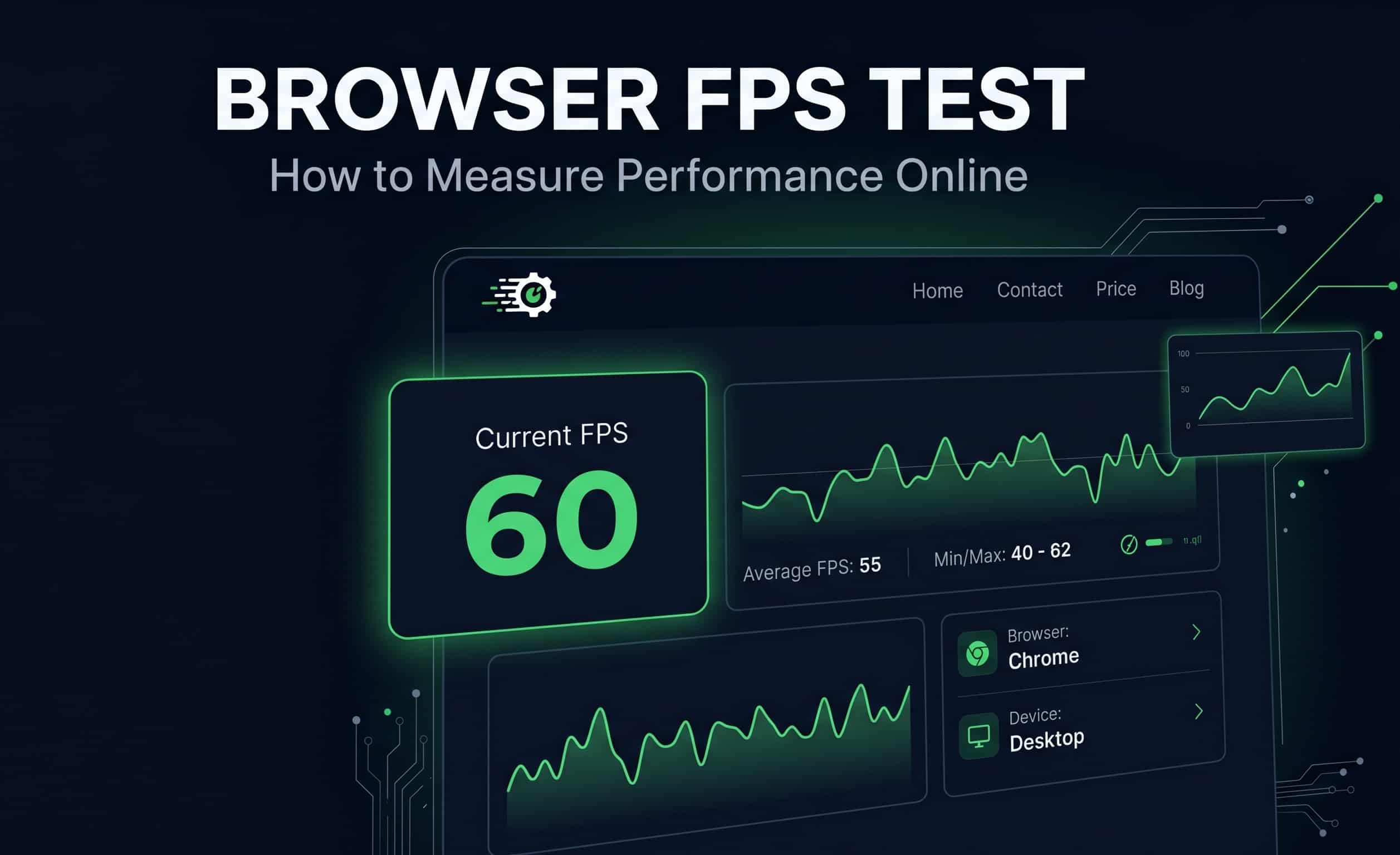
Introduction
Let’s be real for a second. Have you ever been scrolling through a website, and it just feels choppy? Or maybe you’re in a video call, and the other person’s face keeps freezing? That’s your frame rate dropping, and it’s annoying.
Most people think FPS (Frames Per Second) only matters for gaming. Not true. Your browser relies on it too. Every time you scroll, watch a video, or use a web app, your system is pumping out frames.
What is a browser FPS test?
Simply put, it measures how smoothly your browser is running right now. It’s a quick health check for your system.
Why does it matter?
Because a low FPS means lag, Stuttering. A terrible user experience. And if you’re working online all day? That’s a productivity killer. A quick test can tell you if your computer is struggling, or if it’s just a browser setting gone wrong.
What Is FPS?
Alright, let’s break down the basics. FPS stands for Frames Per Second.
Think of it like a flipbook. Each page is a “frame.” The faster you flip, the smoother the motion. In your browser, FPS is the number of images your screen draws every single second.
Here’s the quick breakdown of what different numbers mean in practice:
30 FPS (The Bare Minimum)
It works. You can read text, click links, and watch basic videos.
But you’ll notice choppiness when scrolling or during animations. It’s not smooth it’s just acceptable.
60 FPS (The Sweet Spot)
This is the gold standard. Most monitors run at 60Hz, so 60 FPS feels fluid and responsive.
Scrolling feels like silk. Animations don't stutter. Honestly, this is where most people should be.
120 FPS+ (The "Butter" Zone)
This is for people with high-refresh-rate monitors (120Hz, 144Hz, etc.).
The motion is almost lifelike. But here’s the catch: if your monitor only does 60Hz, you won’t actually see those extra frames. Your screen simply can't keep up.
What Is a Browser FPS Test?
So, what’s actually happening when you run one of these tests?
How it works: The test uses a browser API called requestAnimationFrame. Fancy term, but here’s what it does it tells the browser to run a specific animation and counts exactly how many times it can draw that animation in one second. It’s the same code that games and interactive sites use.
Why use it instead of something else?
It’s real-time. It measures your actual performance right now including the effects of your GPU, CPU load, open tabs, and even power settings.
No downloads. You don’t need to install a heavy benchmark tool.
It’s honest. It tells you if your system can handle modern web apps or if it’s about to give up.
Look, this isn't a replacement for a gaming benchmark. But for testing if your browser is healthy? It’s perfect.
How to Run an FPS Test Using fps-tester.com
Alright, enough talk. Here’s exactly how to check your performance using my tool, fps-tester.com. I built this thing specifically to be easy to use no pop-ups, no installs.
Follow these steps:
1. Hit the "Start FPS Test" Button
Go to the site. You’ll see a big, obvious button. Click it.
The counter will start ticking immediately.
2. Let It Run for 10–15 Seconds
Don't rush it. The first couple of seconds are a "warm-up." Let the system settle.
Watch the Baseline FPS number. This is your idle performance what your system does with almost no load.
3. (Optional) Push Your System in the Stress Test Lab
This is where it gets fun. Once you have a baseline, hit one of the presets: Light → Medium → Heavy → Max.
Or, get specific. Drag the Animated Objects slider or crank up the Blur / Glow.
Watch the live canvas. Does your FPS tank? That tells you exactly where your bottleneck is.
4. Check the Readouts
FPS Counter: Your current speed.
Frame Time (ms): Lower is better. ~16ms = 60 FPS. ~8ms = 120 FPS. If you see 30ms+? That's stutter city.
Δ FPS vs idle: This is my favorite metric. It shows the drop in FPS under load. If it stays near 0, your system has plenty of headroom. If it's a big negative number? You're hitting a wall.
Understanding Your FPS Results
Okay, you got a number. What the heck does it mean?
Don’t just look at the big shiny number. Look at the consistency.
Here’s a cheat sheet for your results:
15–29 FPS (Very Low / Slideshow)
You’ll feel it. Movement is jerky. Interactions feel delayed.
This usually means your device is overwhelmed. Maybe too many tabs open, or you’re on a very old machine.
30–59 FPS (Playable but Choppy)
It's fine for basic stuff. You can read articles.
But you’ll notice the stutter when scrolling fast or watching animations. It’s not a dealbreaker, but it’s not great.
60–119 FPS (Smooth)
This is where you want to be. Everything feels responsive.
If you have a standard 60Hz monitor, you physically can't go higher than this. So if you're hitting 60, you're maxing out your screen.
120+ FPS (Butter)
Only if you have a high-refresh monitor (120Hz, 144Hz, etc.).
The difference is noticeable. Once you go this high, going back to 60 feels slow.
Pro Tip: Don't get obsessed with the FPS number alone. Look at Frame Time. You can have 60 FPS on average, but if one frame takes 30ms and the next takes 5ms, you’ll feel a "hitch." Consistency beats a high peak number.
What Affects Your Browser's FPS?
A bunch of things can mess with your FPS. It’s rarely just one thing.
Here are the usual suspects:
GPU Performance: This is your graphics card. Dedicated GPUs (NVIDIA, AMD) are way faster than integrated ones (Intel UHD). For browser stuff, even integrated should handle 60 FPS. If it doesn’t, something else is wrong.
CPU Load: Your processor handles the "brain" work. If you have heavy sites with lots of JavaScript running (think Google Docs, or heavy dashboards), your CPU gets hammered. That lowers FPS.
RAM and Open Tabs: Chrome is a memory hog. We all know it. Every open tab eats up RAM and CPU cycles in the background. The more tabs, the less resources for your active tab.
Browser Settings & Extensions: Ad-blockers are great, but they inject code into every page. Too many extensions slow things down. Also, if you have "Hardware Acceleration" turned off? That's a huge problem (more on that in a sec).
Power Settings (Battery vs. Plugged In): If you’re on a laptop running on battery, Windows or macOS will throttle your performance to save power. Your FPS will drop immediately. Plug it in!
How to Improve Your Browser FPS
Got a low score? Don't go buying a new PC just yet. Try these quick fixes first. I guarantee one of these will give you a boost.
1. Close Unused Tabs
Seriously. Just close them. Use a tab suspender extension if you must. Free up that RAM.
2. Turn ON Hardware Acceleration
This is the #1 culprit. When it’s off, your CPU does all the rendering work it's slow.
In Chrome: Go to Settings → System → Enable "Use hardware acceleration when available."
In Edge: Same process. Turn it on and restart the browser. Instantly better.
3. Update Your GPU Drivers
Old drivers cause stutters. Don't rely on Windows Update to get the newest ones.
Go to NVIDIA, AMD, or Intel’s website. Download the latest driver for your card. It takes 5 minutes.
4. Plug in Your Laptop
If you're on battery, switch to "High Performance" mode in your power settings. It makes a massive difference.
5. Try a Different Browser
I know, I know. Everyone has their favorite. But Firefox, Edge, and Chrome all render pages differently. Sometimes, Edge runs smoother on one machine, while Firefox runs better on another. It's worth a test.
Browser FPS vs. Gaming FPS
People ask me this all the time. "Hey, I got 120 FPS in the browser test! Does that mean I can run Cyberpunk at max settings?"
Short answer: No. Absolutely not. But let me explain why.
Browser FPS is a light workout. It’s drawing rectangles, text, and CSS animations. It uses the GPU, sure, but it's mostly 2D work. Browsers also have VSync turned on by default, which locks your FPS to your monitor's refresh rate. So a weak system can often hit 60 FPS in a browser because it's just not that hard.
Gaming FPS is a marathon. Full 3D rendering. Textures, shadows, lighting, physics, AI. It hammers your GPU and CPU way harder than a webpage ever will.
When does browser FPS actually matter?
If you work in web apps (like Figma, or heavy dashboards).
If you do a lot of video conferencing.
If you want to check if your system is healthy.
If your browser can't hit 60 FPS on a simple test, something is fundamentally wrong with your setup.
Use a browser test to check your system health. Use a game benchmark to check your gaming power. Different tools for different jobs.
Frequently Asked Questions
What is a good FPS for a browser?
60 FPS. That’s the standard. If you have a 144Hz monitor, you can shoot for 144, but for everyday browsing, 60 is perfectly smooth.
Is browser FPS the same as gaming FPS?
Nope. See the section above. Browser FPS is a health check. Gaming FPS is a performance brag.
Why does my FPS drop when I switch tabs?
Browsers intentionally do this to save battery and CPU. When a tab is in the background, the browser throttles it to maybe 1 FPS. It’s normal. Bring the tab back into focus, and your FPS will return to normal.
How can I increase FPS on a weak laptop?
Plug it in. Turn on Hardware Acceleration. Close everything except the test. If that doesn’t get you to 60 FPS, your laptop might just be too old for modern heavy websites.
Why does my FPS look too good compared to games?
VSync and low graphical demand. A browser simply isn't pushing your GPU as hard as a game.
Conclusion
Let’s wrap it up.
Your browser’s FPS tells you a lot about your system’s health. If it’s low, you'll notice it in everything you do scrolling, typing, watching videos. It's not just for gamers.
Here’s the bottom line:
1. Run a test to see where you stand.
2. If you’re below 60 FPS, try the fixes I mentioned (Hardware Acceleration, close tabs, update drivers).
3. Understand that this is a browser test, not a gaming test.
Ready to see your numbers?
Head over to fps-tester.com and hit that big Start button. Let it run for 15 seconds.
And hey, don't forget to mess around with the Stress Test Lab. Crank up the blur and see if your computer starts sweating. It's honestly the best way to figure out if your machine has any real headroom left, or if it's time to start saving up for an upgrade.
Go give it a try. It only takes a minute.