What Exactly is Reaction Time?
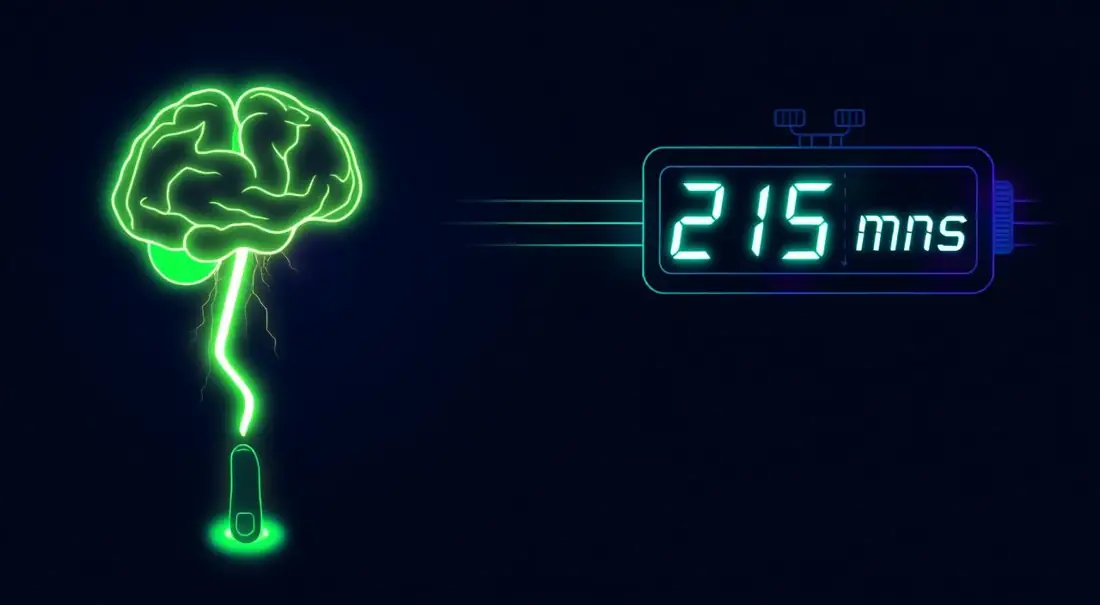
Reaction time is the interval between a visual stimulus appearing and your physical response to it. When a target pops up on screen, your eyes detect the change, your brain processes what it means, and your hand executes a click. The entire sequence typically takes 200–250 milliseconds for most adults, though gamers and athletes often dip below 200 ms through repetition and focus.
It is not just about raw speed. Reaction time depends on several factors: nerve signal travel time, visual processing, decision-making speed, and motor execution. Your monitor's refresh rate and your mouse's polling rate add a small but measurable delay, but the largest chunk comes from your brain's decision step.
Visual vs. Audio Reaction Time
Most people react faster to sound than to light. The average audio reaction time is around 140–160 ms, while visual reaction time typically sits at 200–250 ms. That is because the auditory pathway is simpler: sound waves hit your ear, the cochlea converts them to electrical signals, and they travel straight to the brainstem with less processing overhead than vision requires.
Visual signals take a longer route. Light hits your retina, gets processed by multiple layers of cells, then travels through the optic nerve to the visual cortex at the back of your brain. Your brain also has to interpret shape, color, and motion before deciding to act. All of that extra work adds 40–80 ms compared to hearing a simple beep.
This difference matters in gaming and real-world tasks. A sudden gunshot or footsteps behind you often triggers a swivel before you consciously spot the threat. Many competitive players use audio cues as an early-warning system because their ears give them a head start their eyes cannot match.
Why Does Your Score Fluctuate So Much?
It is completely normal to swing 30–80 ms between attempts even when you feel locked in. Reaction time is not a fixed stat like CPU clock speed it is a living biological process that shifts with your state.
Attention
Hyper-focus pre-loads your motor response and cuts decision lag. The moment your mind drifts, that preload vanishes and your times spike.
Warmup
Your first 2–3 clicks run 20–40 ms slower while your visual-motor system calibrates. Treat early rounds as warmup, not as your real score.
Body State
Caffeine, hydration, sleep, room temperature, and even time of day each nudge your average by 10–30 ms.
Pro Tip
Don't chase a single best score. Track your average across 5–10 rounds it filters out the noise and shows where you actually stand.
Is Your Reaction Time Good? (The Tier List)
Wondering where you actually rank? Here is a no-fluff breakdown of reaction time tiers based on real-world data from gamers, athletes, and everyday clickers. Find your bracket and see what it takes to climb.
Pro-tier reflexes. Top 1% of testers, usually trained gamers or athletes.
Excellent. Competitive gamer territory, fast enough to flick on instinct.
Solid reflexes. Faster than most adults, a healthy baseline.
The big middle. Where the majority of casual testers land.
Tired, distracted, or just starting. A few rounds of practice usually fixes it.
Reality check: Tiers are based on your average across 5+ rounds, not a single lucky click. One 140 ms hit does not put you in S tier any more than one 400 ms fumble drops you to D.
How to Actually Improve Your Score
Reaction time is trainable. You will not turn into a pro overnight, but most people can shave 20–40 ms off their average in a few weeks with the right habits. Here is what actually moves the needle.
Warm Up First
Run 2–3 throwaway rounds before tracking scores. Your visual-motor system needs a few clicks to calibrate, and your real average lives after that warmup.
Loosen Your Grip
Tension slows your fingers. Rest your hand lightly on the mouse, ready but relaxed. A death grip can cost you 15–25 ms instantly.
Fix Your Cursor Anchor
Park your cursor near the center of the arena. Less travel distance means faster clicks. Stop chasing targets from the corner.
Sleep > Caffeine
One bad night of sleep adds 30–50 ms. One coffee shaves 5–10 ms. Sleep wins. Caffeine is a bonus, not a fix.
Hydrate
Even mild dehydration makes your brain sluggish. A glass of water before grinding does more than a new gaming mouse.
Practice in Short Bursts
Five focused minutes beats thirty distracted minutes. Mental fatigue tanks reaction speed fast.
The Hardware Truth
A 240 Hz monitor and a 1000 Hz mouse can save you about 10 ms total. Your brain decides in 100+ ms. Spend on sleep before spending on gear.
In competitive games, reaction time matters a lot. The gap between 150ms and 250ms can be the difference between dodging an ability, landing a shot, or winning a clutch round. Pro esports players typically react in 140-180ms - they've trained their brains through thousands of hours of play.
But raw speed is only half the picture. The other half is decision-making - knowing what to react to and filtering out noise. That's why experienced players with "average" reaction times can still beat newcomers with faster reflexes. Game sense and pattern recognition stack on top of your biological speed.
The Science Behind Reaction Time
When a target pops up, your body goes through a whole chain: light hits your retina, photoreceptors convert it to electrical signals, those signals travel to your visual cortex (about 20-40ms), your brain recognizes the target and decides to click (50-100ms), the motor cortex fires signals to your hand (30-50ms), and your finger physically clicks (10-30ms).
All of that adds up to at least 100-120ms, which is why anything under 100ms is almost certainly you guessing rather than reacting. The biggest variation between people is in that decision-making step - trained gamers have made it nearly automatic through repetition.
Getting Faster
Don't take your first round seriously. Your brain needs a few clicks to get into the rhythm. Treat the first 2-3 attempts as warmup and start paying attention to your scores after that.
Tension kills speed. If you're gripping your mouse hard, your finger actually moves slower. Let it rest lightly on the button, ready but relaxed. Keep your cursor somewhere near the middle of the arena so you don't have to travel far when a target pops up on the opposite side.
Sleep and hydration affect your scores more than you'd think. Studies have shown that 24 hours without sleep impairs reaction time about as much as being legally drunk. And even mild dehydration (losing 1-2% of your body weight in water) makes your brain sluggish. Grab a glass of water before you start grinding for a new personal best.
Reaction Time in Different Esports
Different games test different kinds of reaction. In CS2 and Valorant, it's raw visual reaction: spot the enemy, click the head, faster wins. In League of Legends and Dota 2, reaction matters for dodging skillshots and reacting to ganks, but game sense matters more overall. Fighting games like Street Fighter and Tekken need reactions for blocking mixups, but reads and predictions are what separate good players from great ones.
Fast reactions help in all of these, but they're rarely the deciding factor. Game knowledge, positioning, and prediction do more heavy lifting than shaving 20ms off your click speed. That said, making sure your hardware isn't adding unnecessary lag helps - check your mouse polling rate and monitor refresh rate to make sure you're getting the most out of your setup.