Reaction Time by Age and Game Genre: What's Actually Average?
August 5, 2026
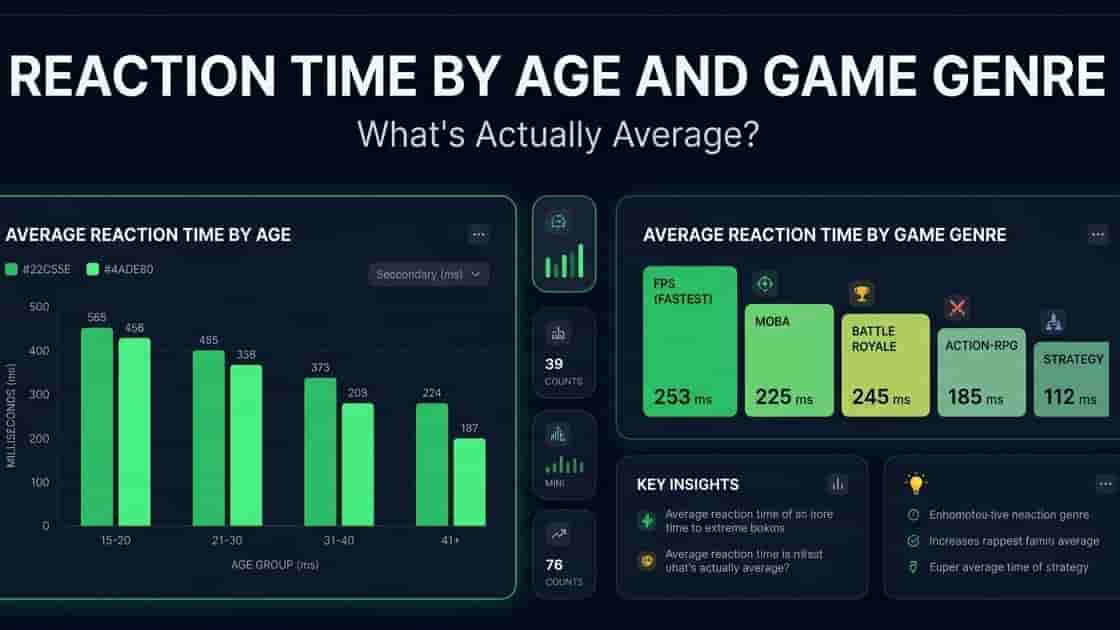
You just ran a reaction time test and got 210 milliseconds. Is that good? Bad? Completely average? Without context, a single number doesn't mean much — reaction time varies a lot depending on your age and, surprisingly, the type of game you play most.
Here's what the data actually shows.
What "Reaction Time" Really Measures
Reaction time is the gap between a stimulus appearing (a flash on screen, an enemy peeking a corner) and your physical response (a click, a key press). It's split into two parts:
Visual processing -how fast your brain recognizes what it just saw
Motor response -how fast your hand executes the click or keypress
Most online tools, including simple reaction time tests, measure the combined total. Elite gamers train both halves, but visual processing is usually the main problem for most people.
Average Reaction Time by Age
Reaction speed isn't fixed, it follows a fairly predictable curve across a person's life:
Under 12: 350–450ms -still-developing neural pathways mean slower processing
13–19: 250–280ms-- near-peak territory, but decision-making and experience haven't caught up yet
20–29: 200–250ms -the physiological peak for most people
30–39: 220–260ms -a gradual but noticeable slide begins
40–49: 250–300ms
50+: 300ms and climbing -reaction time slows roughly 3–5ms per year past 40 for most people who don't actively train it
The takeaway: if you're in your 20s and testing above 280ms, that's not really an age problem, it usually points to fatigue, screen input lag, or an unpracticed test, not a hard biological ceiling.
Average Reaction Time by Game Genre
This is the part most articles skip, but it matters. Different genres reward completely different reflex profiles, so comparing your FPS reaction time to a MOBA player's isn't really apples to apples.
Competitive FPS (Valorant, CS2, Apex Legends) Top-tier players average 150–180ms in-game, with the best pros dipping under 140ms in isolated tests. FPS is the most reaction-time-dependent genre because a single frame can decide a duel.
Fighting Games (Street Fighter, Tekken) Elite players average 130–170ms often the fastest of any genre, since fighting games demand split-second reads on frame-perfect inputs.
MOBAs (League of Legends, Dota 2) Average competitive players sit around 200–230ms. Raw reflexes matter less here than decision-making speed, map awareness, and prediction you're reacting to patterns more than single flashes.
Racing Games (iRacing, Gran Turismo) Skilled racers average 180–220ms. Reaction time affects braking points and collision avoidance, but consistency matters more than raw speed.
Casual/Puzzle Games Reaction time is largely irrelevant here, and average players test in the 250–300ms range similar to the general population baseline.
Why the Gap Between Genres Exists
It's not that FPS players are born faster. It's practice specificity. Reaction time is trainable, and the brain gets efficient at whatever stimulus-response pattern it repeats thousands of times. A CS2 player has drilled "see head, click" so often that the pathway is nearly automatic. A MOBA player has instead drilled prediction and pattern recognition, which shows up as slightly slower raw reaction numbers but faster overall decision-making in their actual game.
How Pro Esports Players Compare
For context, here's where competitive benchmarks land:
Average adult: 250ms
Average gamer: 200–220ms
Semi-competitive player: 180–200ms
Pro esports athlete: 150–180ms
Elite outliers: sub-140ms (rare, and often specific to isolated click tests rather than full in-game reaction)
Even a 30–40ms gap between "good" and "pro" might sound tiny, but at competitive levels, it's the difference between winning and losing a duel.
Can You Actually Improve Your Reaction Time?
Yes, within limits. A few things that genuinely help:
Reduce input and display lag — a high refresh-rate monitor and low-latency mouse can shave real milliseconds off your effective reaction time, separate from your biological speed
Sleep and hydration — fatigue alone can add 20–40ms to your reaction time
Targeted practice — aim trainers and reaction-based drills build the specific neural pathway you're trying to speed up
Reduce caffeine crashes — caffeine helps short-term, but the crash afterward can slow you down more than baseline
Warm up before competitive play — cold reflexes are measurably slower than warmed-up ones, similar to physical muscles
What generally doesn't move the needle much: age-defying supplements, most "brain training" apps beyond the specific skill practiced, and one-off testing without regular practice.
FAQ
What's a good reaction time for gaming? Anything under 200ms is solid for competitive play. Under 170ms puts you in serious competitive territory.
Does reaction time really matter in MOBAs if it's not primarily FPS-driven? It still matters for skill-shot dodging and combos, but decision-making speed matters more overall.
Why did my reaction time get worse as I got older? Some slowdown after your late 20s is normal and biological. Regular practice can offset a meaningful portion of it.
Can I trust an online reaction time test as an accurate measurement? It's a good relative measurement track your own trend over time rather than comparing directly to someone else's setup, since monitor refresh rate and input device both affect the number.
Conclusion
Reaction time isn't just one number that applies to everyone the same way. Your age sets a rough baseline, but the game genre you play most shapes what "average" and "good" actually look like for you. An FPS player chasing sub-180ms and a MOBA player sitting comfortably at 220ms can both be performing at the top of their game they're just optimizing for different things.
The real value in knowing these benchmarks isn't bragging rights. It's context. If your number is higher than you'd like, the fix usually isn't "get younger" it's better sleep, less lag in your setup, and consistent practice in the specific pattern you're trying to speed up. Track your own trend over time, and use the averages above as a rough map, not a verdict.