Reaction Time by Esport: CS2 vs. Valorant vs. League vs. Fighting Games
August 4, 2026
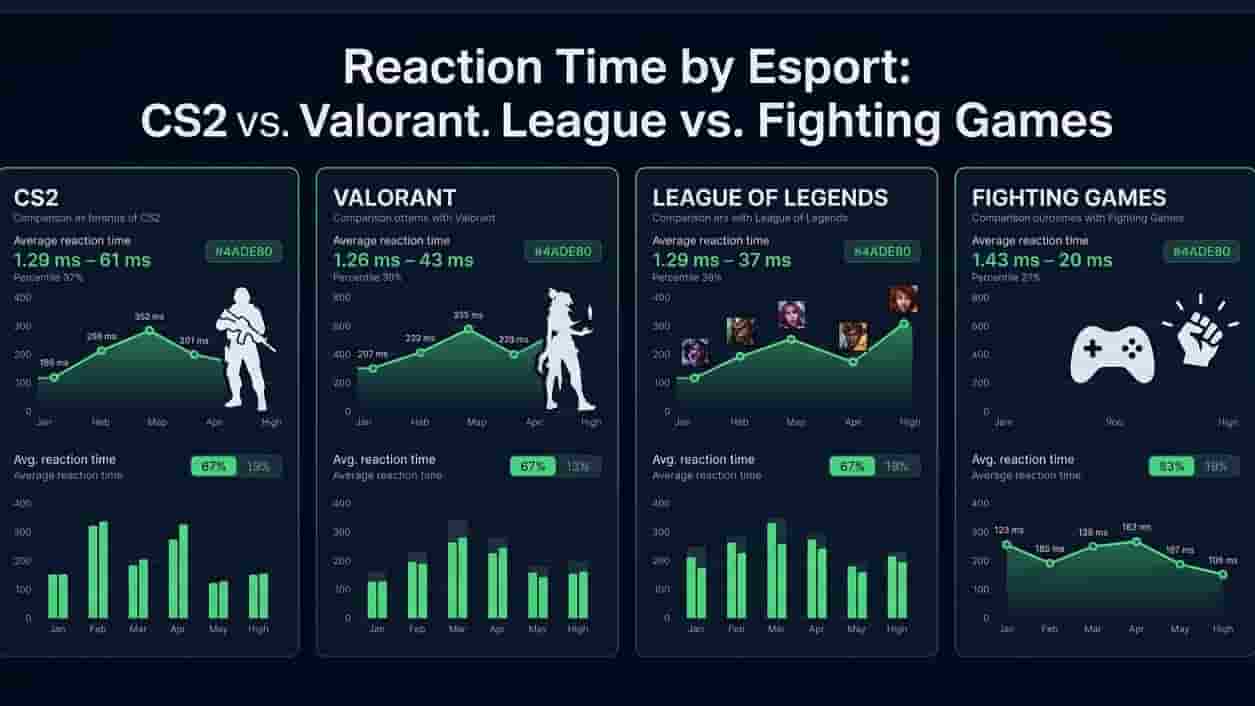
Ask ten gamers what "good reaction time" means and you'll get ten different answers, depending on what they play. And honestly, they're all kind of right. A CS2 player and a League player are using completely different skills, even though both would call it "reaction time."
Let's break down what reaction time actually looks like in each genre, and why some games lean on it way more than others.
First, What Do We Even Mean by "Reaction Time"?
Simple version: it's how long it takes your brain to notice something and tell your hand to do something about it. See a flash, click a button that gap is your reaction time.
For most people, that gap sits around 200-250 milliseconds. Trained gamers usually get that down to somewhere around 180-200ms. The fastest pros in the world? Some get close to 150ms, though once you're that fast, a chunk of it starts blending into prediction rather than pure reaction.
Okay, now let's get into the actual games.
CS2: Every Millisecond Actually Shows Up on Screen
Counter-Strike is basically a pure reaction time test wearing a video game as a disguise. An enemy peeks a corner, you either win the duel or you don't, and a lot of that comes down to who reacted first.
A few reasons it matters so much here:
Duels are often decided in under half a second
Footstep and gun sounds give you a head start good players react to sound before they even see anyone, since your ears are a little faster than your eyes
Crosshair placement matters just as much as raw speed. If your crosshair's already where the enemy's head is about to be, you need way less reaction time to win the fight
Pro CS2 players tend to test somewhere in the 150-170ms range on simple reaction tests. Genuinely fast but it's not magic. A lot of it comes from muscle memory built over thousands of hours, not just naturally quick reflexes.
Valorant: Reaction Time Matters, But It's Not the Whole Story
Valorant looks a lot like CS2 on the surface, same tactical shooter bones but there's a layer on top: abilities. Flashes, smokes, walls, all of that changes things.
Here's the thing, abilities often mean you're reacting to less information, not more. Get flashed and you can't see anything, so raw visual reaction time doesn't even apply. Instead, good Valorant players lean on:
Pre-aiming common angles before they even peek
Reacting to sound cues, same as CS2
Predicting where the enemy probably is, based on the round and their agent
So yes, reaction time still matters a ton in duels. But Valorant rewards game sense and smart utility use almost as much as pure speed. A slightly slower player with better positioning can absolutely beat a faster one who's out of place.
League of Legends: More Brain, Less Reflex
This is where things flip. League isn't really a "who clicked first" game most of the time. It's a "who made the smarter call" game.
That's not to say reaction time is irrelevant. Dodging a skillshot, like getting out of the way of a Lux laser or a Blitzcrank hook, absolutely takes quick reflexes. Some of those abilities are fast enough that you need to already be moving before they're even thrown.
But compare that to CS2, where nearly every fight is a reaction test. In League, most of your time goes toward:
Reading the minimap
Tracking enemy cooldowns
Deciding when to engage or back off
Juggling a dozen small decisions at once
Pro League players don't necessarily have faster reaction times than pro shooter players. What they usually have is faster decision-making, a related skill, but not quite the same thing.
Fighting Games: Too Fast to React, So Players Cheat the System
This one surprises people. Fighting games look like they'd be the ultimate reaction time test, frame-perfect inputs, split-second punishes, all of it. And at the very top level, reaction time does matter more here than almost anywhere else.
But here's the twist. A lot of fighting game moves are specifically designed to be too fast to react. If a move connects in under roughly 200 milliseconds, average human reaction time genuinely isn't fast enough to block it on reaction alone.
So what do top players actually do? They predict. They read patterns. They notice a habit in how their opponent plays and reacts to the pattern, not the move itself. Fighting game players sometimes call this "yomi," basically reading your opponent's next move a half-step ahead.
Reaction time still matters for anything slower than that unreactable window, punishing a blocked move, reacting to something clearly telegraphed. But the fastest, scariest stuff in fighting games isn't won with reflexes. It's won with guesswork built from experience.
Can You Actually Train This?
A bit, yeah. You're not turning a 250ms reaction time into 150ms overnight, that's just not realistic. But you can shave off some time and get more consistent, through things like:
Practicing aim trainers or reaction drills regularly
Getting enough sleep, seriously, tired brains react slower, this one's underrated
Cutting down on distractions while you play
Making sure your monitor and mouse aren't quietly adding lag of their own
That last one trips people up more than they'd expect. You can have great natural reflexes and still test slowly because your gear's holding you back.
FAQ
What's a good reaction time for gaming?
Anywhere from 200-250ms is normal. Under 200ms is solid. Pro-level usually sits somewhere around 150-180ms.
Does reaction time matter more in FPS games than MOBAs?
Generally yes, for raw click speed. But MOBAs test a different kind of speed, decision-making, and that matters just as much in its own way.
Can fighting game players really not react to fast moves?
Not purely on reaction, no. A lot of what looks like reaction at the top level is actually prediction, built on patterns and habits.
Is reaction time something you're just born with?
Mostly your genetics set the baseline, but sleep, focus, and practice can move the number more than people expect.
Test Your Own Reaction Time
Curious where you land? Try our Reaction Time Test and see how you compare. If your gear might be part of the problem, check your FPS Test and Mouse Polling Rate Test too.